Rotator cuff tear after an injury · St. Louis
A rotator cuff tear after an injury is common on MRI and hard to date. The record, not the scan, has to do the dating.
A rotator cuff tear after an injury is a tear in one of the four shoulder tendons that follows a fall, a crash or a lift. Cuff changes are common on MRI even without pain, so the image alone cannot say when a tear began. The exam, the timeline and a diagnostic injection carry that weight.
Both sides make the same mistake with shoulder imaging. One reads any tear as new. The other reads any tear in a 50-year-old as old. The research supports neither reading on its own.
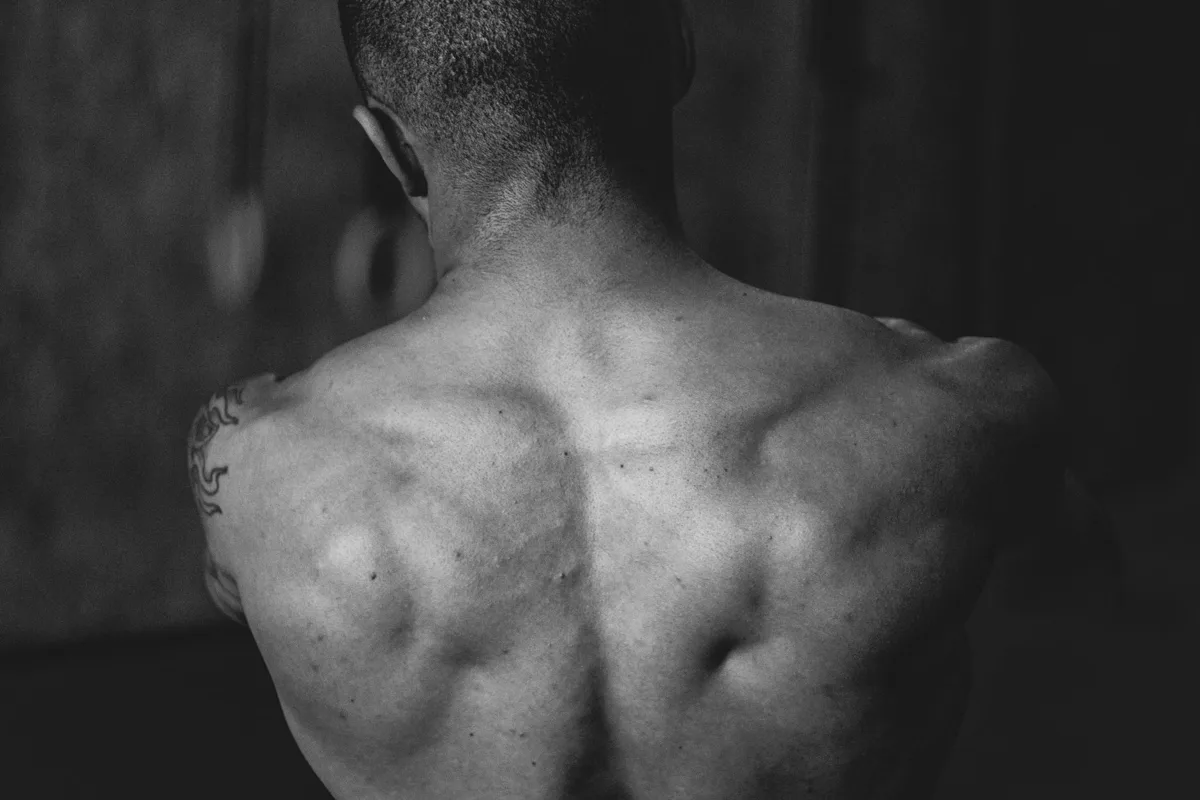
How does an injury tear the rotator cuff?
The cuff is four tendons that hold the ball of the shoulder in its socket and steer the arm. They are built for control, not for stopping a falling body.
Injury cases tend to involve a few mechanisms. A fall on an outstretched arm. A shoulder that comes out of joint. Bracing against a steering wheel. A side impact against a door. A sudden heavy lift at work. Tears are partial, through part of the tendon, or full-thickness, all the way through. Partial tears are more common.
Symptoms often trail the event by days. Neck pain and adrenaline can mask a shoulder for a week or more. A first note that lists the neck and not the shoulder is common, and it is not proof the shoulder was uninjured. It is also not proof that it was. The next notes decide that.
Can an MRI tell when a rotator cuff tear happened?
Not by itself. A pooled analysis of 30 studies and 6,112 shoulders found cuff abnormalities in 9.7% of people age 20 and under and in 62% of people 80 and over. The rise was similar with or without symptoms. The authors concluded that cuff change is a common part of aging and that it is hard to tell from imaging alone whether an abnormality is new.
Some image features lean one way or the other. Fresh fluid, bone bruising and swelling around the tendon lean toward a recent event. Muscle wasting, fatty change in the cuff muscle and a tendon that has pulled far back lean toward an older tear, because those changes take months to develop. None of these is decisive alone. Each should be named in the radiology read or the treating note, not left for a later witness to infer. Our page on imaging and clinical correlation covers the general rule.
The strongest dating evidence is usually functional: what the shoulder did before the event (work duties, sports, prior treatment or its absence) against what it does now. A shoulder with years of unrestricted use and no prior care that fails after a defined event has changed. A shoulder with prior injections and an old MRI showing the same tear has a different history, and the record should say so.
What does a diagnostic injection add?
A subacromial anesthetic injection is the shoulder’s version of a diagnostic block. Numbing medicine is placed in the space above the cuff. If strength returns and pain falls on repeat testing, the pain likely comes from the cuff and the space around it. If strength stays poor despite good relief, a larger tear becomes more likely.
To mean anything, the test needs a written before and after: the same movements, the same pain scale, the same strength test, a stated time window, and the image showing where the needle went. An injection noted only as “patient felt better” is not a diagnostic test. It is an anecdote.
How is orthobiologic treatment for a rotator cuff tear documented?
Platelet-rich plasma (PRP) is used for partial tears that have not responded to rehab. A 2022 review of 11 controlled trials and 641 patients found PRP for partial tears improved pain and shoulder function compared with placebo at every follow-up point, and compared with other conservative care at two to three months and beyond six months.
A defensible orthobiologic record for the shoulder contains, at minimum:
- The diagnosis, with the confirming image and the exam that matches it.
- The conservative care tried first, with dates and response.
- The guidance used (ultrasound, with saved images showing the target).
- The product: volume, platelet concentration if measured, and leukocyte content.
- A validated outcome measure, such as a shoulder function score and a pain scale, at baseline and at set intervals.
PRP is non-covered by most payers. That is a coverage decision, not a finding about evidence, as explained in coverage is not evidence. How future orthobiologic care is projected is covered in orthobiologics, future care and damages.
What should the early shoulder records show?
Good early notes are short and specific. They say which arm, how it was hurt, and when the pain began. They test strength in each direction and record range of motion in degrees. They note night pain. They list any prior shoulder care, or say plainly that there was none. That set of facts is what lets a reader date the tear later. It costs a few minutes at the first visit and saves months of argument.
Which rotator cuff tears are treated without surgery?
Most of them. Conservative care matches surgery for partial-thickness cuff tears, which are about twice as common as full-thickness ones. A 2024 scoping review built on 28 level-1 trials and the systematic reviews around them concluded: “The results of this scoping review do not support superiority of operative over nonoperative management” (Eubank et al., 2024). A 2026 meta-analysis of 33 studies and 1,818 patients found that the differences favoring surgery “remained below the minimal clinically important differences (MCID), indicating limited clinical relevance” (Ricker et al., 2026).
For a partial tear, the treating plan here is conservative: progressive loading of the cuff and shoulder blade, an ultrasound-guided injection when pain blocks the rehab, PRP placed into the tendon when the tear stalls, and attention to the metabolic factors that slow tendon repair. The practice works to avoid surgery on these tears.
Full-thickness tears are the exception. The 2026 long-term review of 16 studies that found rehab-first care comparable for partial tears and lower-demand patients found surgical repair better over time for full-thickness tears. The record test runs both ways: a record that schedules a repair for a small partial tear without a trial of rehab has a gap, and so does one that recommends PRP for a large, full-thickness tear in a young worker without discussing surgery. Either gap is the first thing an opposing expert will find.
Frequently asked questions
Can an MRI show whether a rotator cuff tear is new or old?
Only partly. Fluid, bone bruising and swelling lean toward a recent tear; muscle wasting, fatty change and retraction lean toward an older one. Function before and after the event usually decides it.
Is a partial rotator cuff tear usually treated with surgery?
No. Partial tears are the more common kind, and they are treated conservatively: rehab and loading first, a guided injection when pain blocks the rehab, and PRP into the tendon when a tear does not respond. Full-thickness tears in younger, active patients are the group more often referred for repair.
What does a subacromial injection test prove?
When the same tests are recorded before and after, a clear response localizes the pain to the cuff and the space above it. Without that written comparison it proves little.
Is PRP for a rotator cuff tear investigational?
No. It is studied in randomized trials and meta-analyses and is non-covered by most payers. Coverage status and evidence are separate questions.
Does this practice review shoulder injury records for either side?
Yes. Reviews are taken from plaintiff firms, defense firms and carriers on the same terms. See case review.
Related reading
- Imaging and correlation
- Diagnostic nerve blocks
- Pre-existing degeneration
- Orthobiologics in injury cases
- Post-traumatic arthritis
Sources
- Eubank BHF, Sheps DM, Dennett L, et al. A scoping review and best evidence synthesis for treatment of partial-thickness rotator cuff tears. J Shoulder Elbow Surg, 2024;33(3):e126-e152. PubMed 38103720
- Ricker E, Stehling L, Klute L, et al. Surgical vs. non-surgical therapy for partial tears of the rotator cuff: a systematic review and meta-analysis of pooled studies with indirect comparison. BMC Musculoskelet Disord, 2026;27(1). PubMed 42151917
- Teunis T, Lubberts B, Reilly BT, Ring D A systematic review and pooled analysis of the prevalence of rotator cuff disease with increasing age. J Shoulder Elbow Surg, 2014;23(12):1913-1921. PubMed 25441568
- Zhu P, Wang Z, Li H, Cai Y Platelet-rich plasma injection in non-operative treatment of partial-thickness rotator cuff tears: a systematic review and meta-analysis. J Rehabil Med, 2022;54:jrm00312. PubMed 35892292
- Trygonis N, Loupasis T, Hautz WE, Exadaktylos AK Conservative management of degenerative rotator cuff tears: a systematic review of long-term clinical outcomes and cost effectiveness. J Orthop, 2026;75:232-241. PubMed 41756190
Ask what the record can support
Patients can book an evaluation. Attorneys and carriers can send the imaging and the treatment notes for a review on the same terms either way.
12166 Natural Bridge Rd
St. Louis, MO 63044
Monday to Friday, 8:00 a.m. to 5:00 p.m. Nothing on this page is legal advice, and nothing on it is medical advice.