Herniated disc after injury
The disc is the most photographed structure in medicine and one of the hardest to prove is the problem.
A lumbar disc injury is proven by correlation, not by the scan: disc bulges appear in 30% of asymptomatic 20-year-olds and 84% of asymptomatic 80-year-olds. The finding has to match the examination, the symptom distribution and, where needed, a selective block.
A lumbar disc can herniate without hurting and hurt without herniating. Establishing that a disc is the pain generator in a specific person requires more than the finding on a film, which is exactly where most spine cases are won or lost.
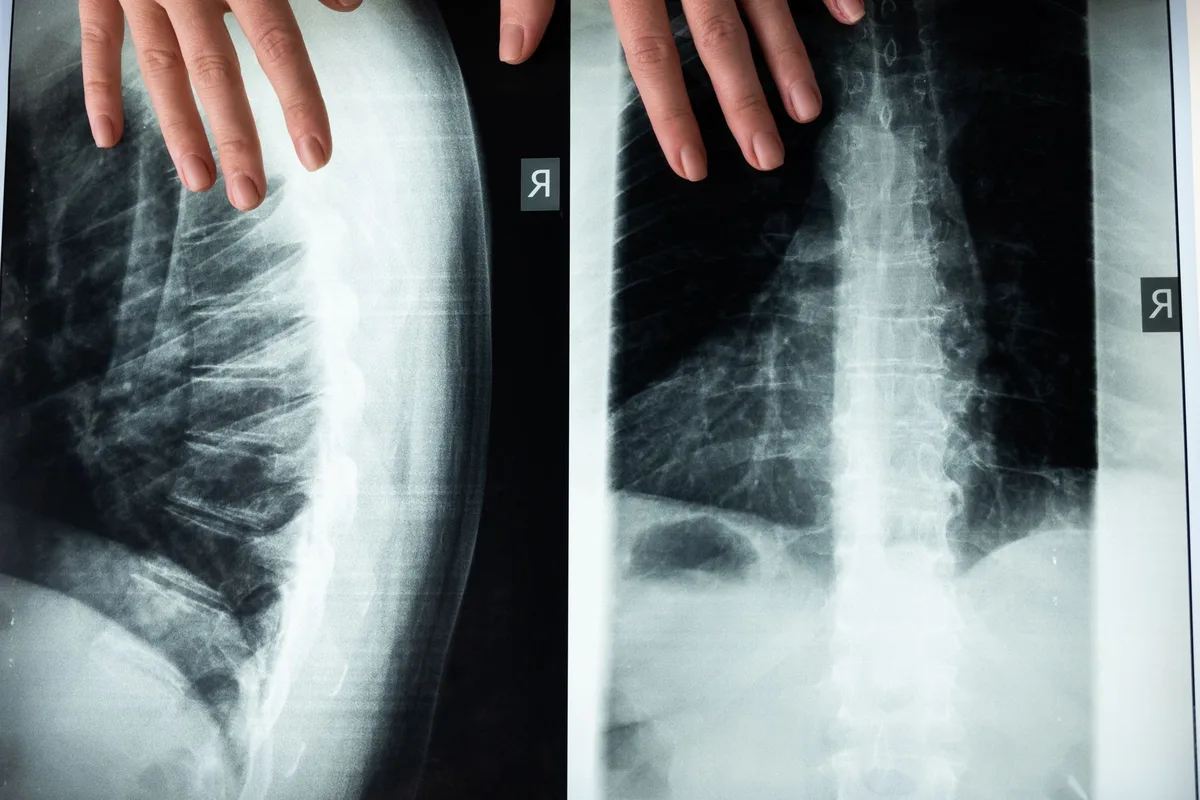
The two questions that are always conflated
IS THERE A DISC ABNORMALITY?
Answered by imaging, and usually yes — disc bulges appear in 30% of asymptomatic 20-year-olds and 84% of asymptomatic 80-year-olds.
IS THAT ABNORMALITY GENERATING THIS PAIN?
Answered by correlation to the examination, by the distribution of symptoms, and where necessary by selective block. Imaging cannot answer it.
A report that answers the first and presents it as an answer to the second is the single most common defect in spine documentation, on both sides.
Radicular versus discogenic
A herniation compressing or chemically irritating a root produces radicular pain in a mapped distribution, testable by examination and sometimes by electrodiagnostics. Discogenic pain — pain from the disc itself — is axial, poorly localized, and much harder to attribute.
The distinction matters for causation and for treatment, and it is worth insisting the record makes it rather than using “disc injury” for both.
Dating a herniation
Rarely possible with confidence from a single post-injury study. Where a prior study exists, comparison is worth more than any single-study feature. Where none exists, the honest position is that the structural change may be chronic and the symptom is what changed — see causation and apportionment.
This practice is not aligned to a side. Its obligation runs to the patient’s health and safety, which is the same reason it is not beholden to any position that would keep it from seeing what is actually there. We do not offer opinions on liability, we do not accept a referral or a review conditioned on reaching a particular conclusion, and we will say plainly when the evidence does not support the claim — whichever party was hoping otherwise.
Common questions
Does a bigger herniation mean more pain?
No. Position relative to the root and the available reserve space matter far more than size.
Can an MRI date the herniation?
Not reliably from one study. Comparison with a prior study is the strongest available evidence.
What if the patient had back pain before?
Then the question is aggravation, which turns on a documented change in pattern and function — see causation and apportionment.
Is surgery evidence of severity?
It is evidence a surgeon thought it indicated. Severity is established by deficit and function, not by the fact of an operation.
Related reading
- “Pre-existing degeneration”
- Imaging and correlation
- Diagnostic nerve blocks
- Failed back surgery
- Sacroiliac joint injury
Send the films and the symptom distribution
The whole question is whether they agree. That takes one review.
12166 Natural Bridge Rd
St. Louis, MO 63044
Monday to Friday, 8:00 a.m. to 5:00 p.m. Nothing on this page is legal advice, and nothing on it is medical advice.
Sources
- Brinjikji W et al. Systematic literature review of imaging features of spinal degeneration in asymptomatic populations. American Journal of Neuroradiology, 2015. PubMed 25430861
- Boden SD et al. Abnormal magnetic-resonance scans of the lumbar spine in asymptomatic subjects. Journal of Bone and Joint Surgery, 1990. PubMed 2312537
- Cohen SP et al. Multicenter, randomized, comparative cost-effectiveness study comparing 0, 1, and 2 diagnostic medial branch block treatment paradigms before lumbar facet radiofrequency denervation. Anesthesiology, 2010. PubMed 20613471
- Bono CM et al. An evidence-based clinical guideline for the diagnosis and treatment of cervical radiculopathy from degenerative disorders. The Spine Journal, 2011. PubMed 21168100