Post-traumatic arthritis · St. Louis
Post-traumatic arthritis arrives years after the claim is often closed. The baseline record is what lets anyone tell it apart from ordinary wear.
Post-traumatic arthritis is joint wear that follows an injury such as a fracture into the joint, a ligament tear or a meniscus tear. It often appears five to twenty years later and in younger people than ordinary arthritis. Separating it from age-related wear depends on baseline imaging, the uninjured side and the history in between.
Arthritis after an injury is predictable as a risk and unpredictable as an event. That gap is where future-care opinions go wrong, by projecting a replacement that may never come or by ignoring one that is likely.
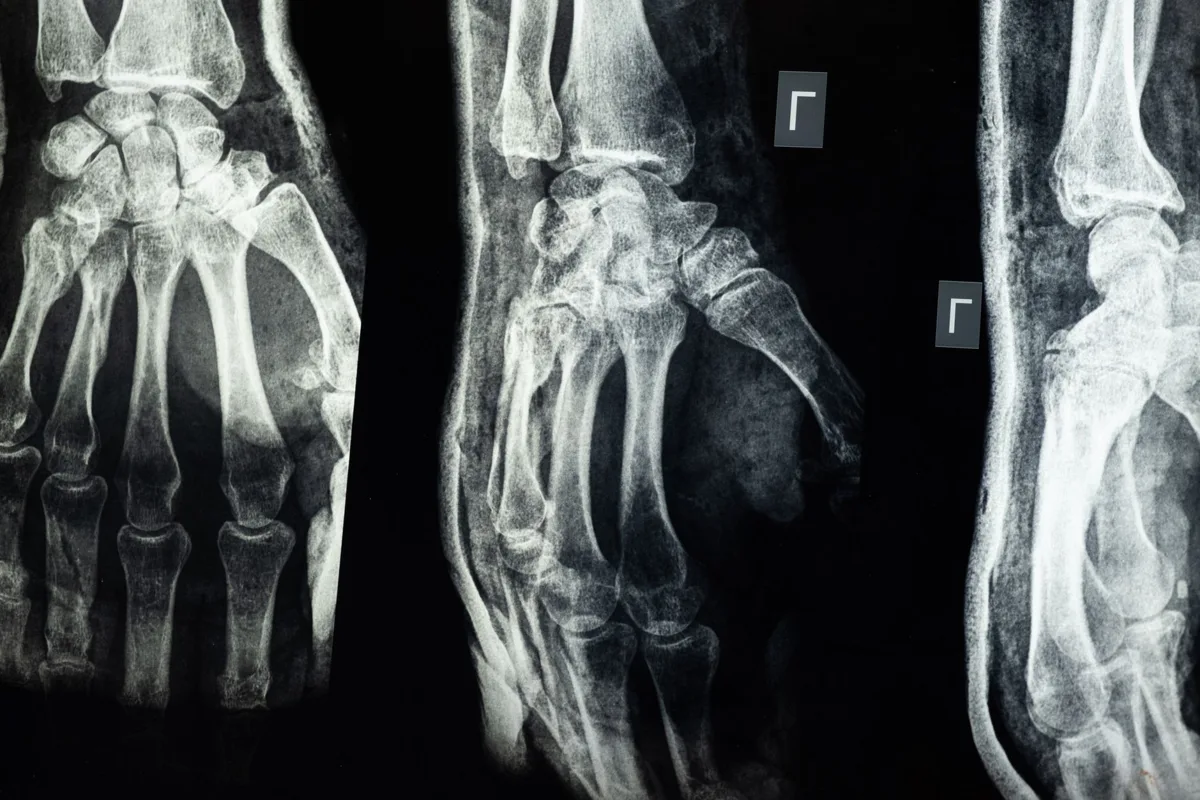
How does an injury cause arthritis?
Three paths lead from injury to early joint wear. A break that runs into the joint can leave a step in the smooth surface. A torn ligament can leave the joint a little loose, so the surfaces rub wrong with each step. A torn or removed meniscus takes away part of the cushion. Swelling inside the joint can also last long after the injury looks healed.
For the knee, the risk has been measured. A 2019 review pooled 53 studies and about one million people. After an ACL injury, the odds of knee arthritis were about four times higher than in an uninjured knee. After a meniscus injury, or both injuries together, they were about six times higher. The authors noted wide variation between studies.
How common is post-traumatic arthritis?
A University of Iowa team estimated that about 12% of painful arthritis in the hip, knee and ankle starts with an injury. That is about 5.6 million people in the United States. The figure came from one clinic and was scaled up to the whole country. It should be cited with that method stated. It also did not count the shoulder, wrist or hand, which the estimate left out by design.
Which joints are most often affected?
The knee leads, because it carries the most load and the most twisting. The ankle follows, often after a bad sprain or a break that healed slightly out of line. The hip can follow a fall or a dashboard injury. The shoulder, wrist and base of the thumb can follow a fall on an outstretched hand. The early signs are the same in each: morning stiffness, aching after a long day, mild swelling after use, and grinding.
What should be recorded at the time of the first injury?
The original injury record is the baseline for everything that follows. It should name the joint and the structure hurt. It should include the first images, ideally of both sides. It should record how the joint moved and how stable it was. If surgery was done, the operative note should say what was removed or repaired. A meniscus that was trimmed is a different future than one that was sewn.
Records like these are rarely made with a claim in mind. They are made to treat the patient. But years later, they are often the only neutral evidence anyone has.
How is post-traumatic arthritis separated from ordinary wear?
The most useful comparison is usually the other side. Ordinary wear tends to show up on both sides. Wear after an injury tends to be one-sided and to match the hurt joint. Standing X-rays of both joints, taken the same day, record that comparison.
The second comparison is time. Imaging near the injury sets a baseline. Later imaging of the same joint shows the change. Without the baseline, any later finding is open to both readings: that the injury caused it, or that it was coming anyway. Our pages on pre-existing degeneration and the eggshell plaintiff cover how a joint that was already worn is handled.
The third is what happened in between. New injuries, weight gain, diabetes and heavy work all affect a joint. A record that ignores them invites the claim that they explain everything. A record that names them can weigh each one. See patient terrain.
How is orthobiologic treatment for post-traumatic arthritis documented?
For knee arthritis, platelet-rich plasma (PRP) now has formal society positions. The 2024 ESSKA-ICRS consensus, using the RAND/UCLA method across 216 scenarios, rated PRP appropriate for patients up to age 80 with Kellgren-Lawrence grade 0 to III arthritis, with the highest agreement after failed conservative or injection treatment. The American Academy of Physical Medicine and Rehabilitation issued a guidance statement on PRP for knee arthritis in 2026.
Dose matters to the record. A 2025 meta-analysis found that the improvement from PRP in knee arthritis was clinically significant and influenced by platelet concentration. So the product should be characterized, not just named.
- The arthritis grade on standing films, and the comparison side.
- The injury that started it, with the original imaging if available.
- Conservative care tried first: strength work, weight and load changes, medication, prior injections.
- Guidance (ultrasound, with saved images), volume and platelet concentration.
- A validated knee or joint score and a pain scale at baseline and set intervals.
How is future care for post-traumatic arthritis projected?
Future care is a range, not a single path. A sound projection states the current grade of wear. It states how fast that joint is likely to change in that patient. It lists the treatments that may delay a replacement, and the age at which a replacement becomes reasonable. It also says what would change the forecast. A forecast that assumes a replacement in every case, or in none, is easy to take apart. See orthobiologics, future care and damages and life-care planning.
Frequently asked questions
How long after an injury does post-traumatic arthritis appear?
It varies by joint and injury. Changes on X-ray often take five to twenty years, sooner after a fracture into the joint or an unstable ligament.
How is post-traumatic arthritis told apart from age-related arthritis?
By comparing the injured joint with the other side, comparing baseline and later imaging of the same joint, and accounting for the history in between.
Is PRP appropriate for post-traumatic knee arthritis?
The 2024 ESSKA-ICRS consensus rated PRP appropriate in many scenarios for grade 0 to III knee arthritis in patients up to 80, especially after other treatments failed.
Does an earlier injury always lead to arthritis?
No. It raises the odds, by about four to six times for major knee injuries, but many injured joints never develop symptomatic arthritis.
Can post-traumatic arthritis be slowed?
Often, yes. Strength work, weight and blood sugar control, load changes and treatments such as PRP can slow symptoms and delay a replacement. They do not reverse the damage. The record should state which were tried, how the joint responded, and over what period, so the next reader can judge the trend for themselves.
Does this practice review future-care projections for either side?
Yes, for plaintiff firms, defense firms and carriers on the same terms. See case review.
Related reading
- Meniscus tear after an injury
- Rotator cuff tear after an injury
- PRP dose and preparation
- Future care and damages
- Imaging and correlation
- Orthobiologics after an injury: PRP, bone marrow and fat
Sources
- Poulsen E, Goncalves GH, Bricca A, et al. Knee osteoarthritis risk is increased 4-6 fold after knee injury: a systematic review and meta-analysis. Br J Sports Med, 2019;53(23):1454-1463. PubMed 31072840
- Brown TD, Johnston RC, Saltzman CL, Marsh JL, Buckwalter JA Posttraumatic osteoarthritis: a first estimate of incidence, prevalence, and burden of disease. J Orthop Trauma, 2006;20(10):739-744. PubMed 17106388
- Kon E, de Girolamo L, Laver L, Andriolo L, et al. Platelet-rich plasma injections for the management of knee osteoarthritis: the ESSKA-ICRS consensus. Knee Surg Sports Traumatol Arthrosc, 2024;32(11):2938-2949. PubMed 38961773
- Bensa A, Previtali D, Sangiorgio A, Boffa A, et al. PRP injections for the treatment of knee osteoarthritis: the improvement is clinically significant and influenced by platelet concentration: a meta-analysis. Am J Sports Med, 2025;53(3):745-754. PubMed 39751394
- Borg-Stein J, Jayaram P, Colorado BS, de Luigi AJ, et al. AAPM&R guidance statement on platelet rich plasma for knee osteoarthritis. PM R, 2026;18 Suppl 2:S20-S35. PubMed 41989317
Ask what the record can support
Patients can book an evaluation. Attorneys and carriers can send the imaging and the treatment notes for a review on the same terms either way.
12166 Natural Bridge Rd
St. Louis, MO 63044
Monday to Friday, 8:00 a.m. to 5:00 p.m. Nothing on this page is legal advice, and nothing on it is medical advice.