EMG and nerve conduction studies
A needle in a muscle does not care what the patient says. It reports what the nerve is doing.
Electromyography and nerve conduction studies measure the electrical behavior of nerve and muscle. They are among the few tests in this area that produce a waveform rather than a rating — and they are also among the most over-claimed, because a normal study does not exclude injury.
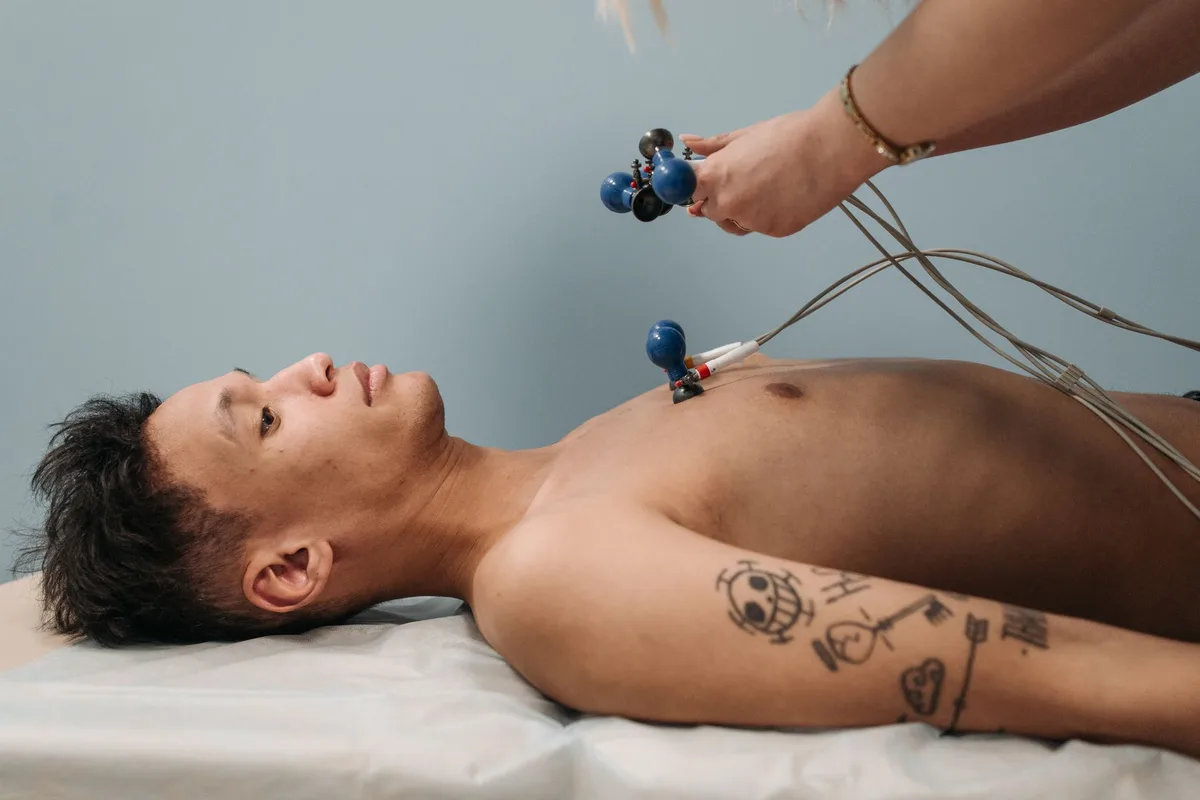
What the study measures
Nerve conduction studies stimulate a nerve and record the response, giving conduction velocity, amplitude and latency. Needle electromyography records electrical activity in muscle at rest and on effort, and can show the changes that follow denervation.
Dillingham and colleagues set out the role of electrodiagnostic assessment in suspected lumbosacral and cervical radiculopathy, including what it contributes beyond imaging and how it bears on treatment and outcome.
The output is a waveform and a set of numbers produced by a machine on tissue. That is the reason it carries weight.
What it establishes, and what it does not
- Establishes: physiological injury to a nerve or root, its distribution, and often its approximate age from the pattern of changes.
- Establishes: a finding independent of the patient’s report.
- Does not establish: pain. A nerve can be injured and not hurt, and can hurt with a normal study.
- Does not establish: causation. It dates the physiology roughly; it does not identify what caused it.
- Insensitive to: purely sensory injury and small-fiber involvement. A normal study in a client with burning, allodynia or numbness is common and is not evidence of exaggeration — that is what sensory testing is for.
Timing matters
Denervation changes on needle examination take time to develop. A study performed too early after an injury can be falsely normal, which is a scheduling fact rather than a clinical finding — and a reviewing expert quoting an early normal study should be asked when it was done relative to the injury.
This practice is not aligned to a side. Its obligation runs to the patient’s health and safety, which is the same reason it is not beholden to any position that would keep it from seeing what is actually there. We do not offer opinions on liability, we do not accept a referral or a review conditioned on reaching a particular conclusion, and we will say plainly when the evidence does not support the claim — whichever party was hoping otherwise.
Common questions
Does a normal EMG mean there is no injury?
No. It means no electrophysiological abnormality was detected on the fibers the test samples. Sensory and small-fiber injury are routinely missed.
Can EMG date an injury?
Approximately, from the pattern of changes. It is a range, not a date, and should be stated as one.
Is the test painful?
The needle portion is uncomfortable for most people and brief. Patients should be told that plainly beforehand.
Does a positive study prove the crash caused it?
No. It establishes nerve injury; causation still rests on timing and mechanism — see causation and apportionment.
Related reading
- Objective corroboration
- Quantitative sensory testing
- Cervical radiculopathy
- Imaging and correlation
- Causation and apportionment
Ask whether electrodiagnostics are indicated yet
Timing changes the result. Send the injury date and the symptoms and we will tell you whether a study now would mean anything.
12166 Natural Bridge Rd
St. Louis, MO 63044
Monday to Friday, 8:00 a.m. to 5:00 p.m. Nothing on this page is legal advice, and nothing on it is medical advice.
Sources
- Dillingham TR et al. Evaluation of persons with suspected lumbosacral and cervical radiculopathy: electrodiagnostic assessment and implications for treatment and outcomes. Muscle & Nerve, 2020. PubMed 32564381
- Bono CM et al. An evidence-based clinical guideline for the diagnosis and treatment of cervical radiculopathy from degenerative disorders. The Spine Journal, 2011. PubMed 21168100
- Raja SN et al. The revised International Association for the Study of Pain definition of pain: concepts, challenges, and compromises. Pain, 2020. PubMed 32694387
- Rolke R et al. Quantitative sensory testing in the German Research Network on Neuropathic Pain (DFNS): standardized protocol and reference values. Pain, 2006. PubMed 16697110