Mild traumatic brain injury
The imaging is normal, which is what the classification predicts, and which is then presented as the finding.
Mild traumatic brain injury is defined in a way that anticipates normal structural imaging. Its overlap with post-traumatic headache and cervical injury is substantial, and untangling which symptom belongs to which is genuinely difficult work that most files do not attempt.
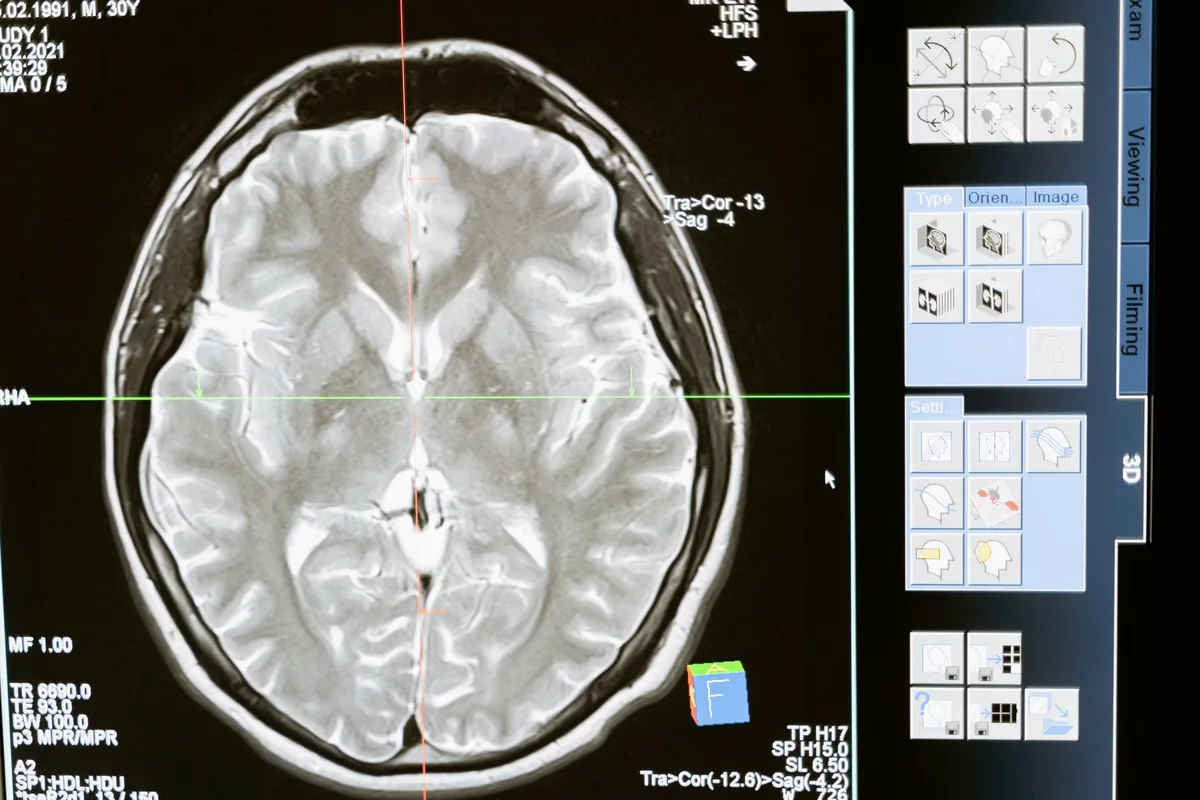
Normal imaging is expected
A normal CT or MRI does not exclude mild traumatic brain injury; the classification is clinical and does not require a structural lesion. A reviewing report treating normal imaging as dispositive has misunderstood the definition, and that is worth putting on the record.
Marincowitz and colleagues systematically reviewed clinical outcome trajectories from three to twelve months after mild traumatic brain injury — a trajectory picture rather than a single expected curve.
The overlap problem
Headache, dizziness, sleep disturbance, concentration difficulty and neck pain follow both brain injury and cervical injury, and both frequently occur in the same collision. Attributing all of it to one is a mistake in either direction.
What can be done is to test the parts that are testable: the cervical contribution with blocks, the headache phenotype against published patterns, and the cognitive complaint with formal neuropsychological assessment including validity measures — see effort and validity testing.
Scope, honestly
This is an interventional pain practice. We evaluate and treat the pain components — headache, cervical, sensory — and we refer the cognitive and vestibular assessment to the appropriate specialists rather than opine outside our scope. A pain physician offering a neuropsychological opinion is an easy target and deserves to be.
This practice is not aligned to a side. Its obligation runs to the patient’s health and safety, which is the same reason it is not beholden to any position that would keep it from seeing what is actually there. We do not offer opinions on liability, we do not accept a referral or a review conditioned on reaching a particular conclusion, and we will say plainly when the evidence does not support the claim — whichever party was hoping otherwise.
Common questions
Does normal imaging rule out a brain injury?
No. The classification of mild traumatic brain injury does not require a structural lesion, and normal imaging is the expected finding.
Can you separate neck pain from brain injury symptoms?
Partly, and the separation is done by testing the cervical contribution rather than by asking the patient to sort it out.
Do you provide neuropsychological testing?
No. We refer it. We interpret the pain components and stay inside that scope.
How long do symptoms usually last?
Trajectories vary, and a substantial minority remain symptomatic at twelve months. A single expected duration is not supported.
Related reading
- Post-traumatic headache
- Whiplash and cervical injury
- Effort and validity testing
- Objective corroboration
- Central sensitization
Ask which symptoms are testable here and which are not
The honest split matters more in this injury than in any other.
12166 Natural Bridge Rd
St. Louis, MO 63044
Monday to Friday, 8:00 a.m. to 5:00 p.m. Nothing on this page is legal advice, and nothing on it is medical advice.
Sources
- Marincowitz C et al. A systematic review of clinical outcome trajectories from 3 to 12 months following mild traumatic brain injury. Journal of Neurotrauma, 2026. PubMed 42433081
- Lyons HS et al. Evaluating the phenotypic patterns of post-traumatic headache: a systematic review. Military Medicine, 2025. PubMed 39028222
- Raja SN et al. The revised International Association for the Study of Pain definition of pain: concepts, challenges, and compromises. Pain, 2020. PubMed 32694387
- Ritchie C, Sterling M. Recovery pathways and prognosis after whiplash injury. Journal of Orthopaedic & Sports Physical Therapy, 2016. PubMed 27594661